Earthrise: the photo that changed how we see Earth – preposition + which and whom in formal English
About this lesson
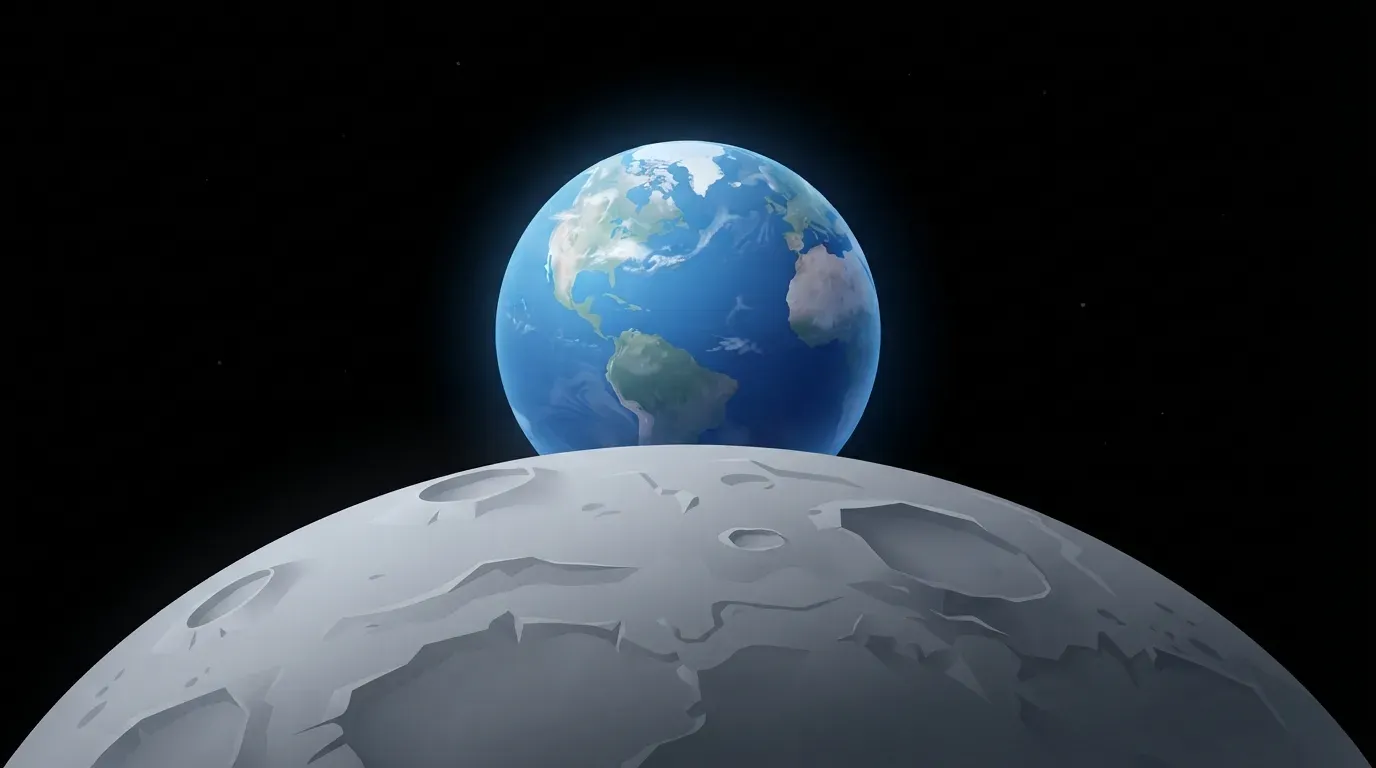
This B2 ESL lesson plan teaches preposition + which and whom through Earthrise, Bill Anders's 1968 color photo of Earth above the Moon, taken on Apollo 8.
- Grammar
- The preposition before which for things, times and places (the moment at which the crew saw Earth) and before whom for people, beside the everyday order (the men he flew with).
- Topic
- Apollo 8's orbits of the Moon and its famous photo, what it may have changed and why the “rise” isn't one, with words such as emerge, far side and iconic.
- Activities
- An explainer, a planetarium debate and a reader's voice memo, self-checking drills, a caption chat and a wheel of questions.
What's inside
Chapter 1Warm-up: one picture, one planet
Chapter 2Let's read: Earth comes up over the Moon
Chapter 3Let's listen: can a photo change your mind?
Chapter 4Grammar: the moment at which Earth rose
- Study the scheme: the moment at which Earth roseGrammar schemeTry it
- Choose the correct optionChoose the optionUnlock
- Fill in the gaps: use the preposition in brackets and which or whomFill in the gapsUnlock
- Fill in the table: one fact, two right waysFill in the tableTry it
- Choose the correct answer: is it right?QuizUnlock
- Drag the words into the gaps: Grover's planetarium showDrag and dropUnlock
Chapter 5Let's talk: pictures worth a debate
Chapter 6Homework
- Match the words and the meaningsMatchUnlock
- Unscramble the wordsAnagramUnlock
- Fill in the gaps with the lesson's wordsFill in the gapsUnlock
- Find the matching pairs: words and meaningsMemory gameUnlock
- Choose the correct option: new sentencesChoose the optionUnlock
- Fill in the gaps: use the preposition in brackets and which or whomFill in the gapsUnlock
- Choose the correct answer: which sentence is correct?QuizUnlock
- Put the words in the correct orderUnjumbleUnlock
- Choose the correct option: captions for a photo archiveChoose the optionUnlock
- Drag the words into the gaps: Leona answers JayDrag and dropUnlock
Space vocabulary
12 words and phrases from the lesson, each with a picture and audio in edio.
+9 more with pictures and audio in the lessonMore words
- spark
- spacecraft
- far side
- delicate
- perspective
- iconic
- roll of film
- black-and-white
- environmental movement
Grammar: preposition + which and whom
In formal English, the preposition of a relative clause can move to the front, before which or whom: the moment at which the crew saw Earth. A space flight brings a crew, a date, orbits and a horizon, so people, times and places all appear. Learners trace each preposition back to the plain fact and set the formal order beside the everyday one.
Preposition + which / whom
In formal English, the preposition goes before which (things, times, places) or whom (people). In everyday English, it can go at the end. Both are right.
Which for things, whom for people
After a preposition, which stands for things, times and places, and whom for people: the mission during which…, the astronauts with whom… With commas, the clause adds a fact: Lovell, to whom Anders turned, looked for color film. Never put that straight after a preposition, and say the preposition once.
Formal: the preposition first
| For… | Say | Example |
|---|---|---|
| things, times, places | preposition + which | the mission during which people first orbited the Moon |
| people | preposition + whom | the astronauts with whom Anders flew |
| extra information, with commas | , preposition + which / whom , | Lovell, to whom Anders turned, looked for color film. |
Which or whom? And say it once
Right after a preposition, use whom for people and which for things, times and places. Never that after a preposition: the astronauts with whom (not with that), the mission during which (not during that). Say the preposition only once: the astronauts with whom Anders flew (not with whom Anders flew with).
Where does the preposition come from?
The plain fact supplies it: Anders flew with two astronauts becomes the two astronauts with whom Anders flew, and at that moment becomes the moment at which. Find the preposition in the fact, then move it forward.
Where does the preposition come from?
| The fact | The relative clause |
|---|---|
| Anders flew with two astronauts. | the two astronauts with whom Anders flew |
| Earth appeared above the horizon. | the horizon above which Earth appeared |
| The crew saw Earth at that moment. | the moment at which the crew saw Earth |
| Apollo 8 entered lunar orbit on December 24. | the day on which Apollo 8 entered lunar orbit |
Apollo 8, formally
- Apollo 8 was the mission during which people first orbited the Moon.
- December 24, 1968, was the day on which Apollo 8 entered lunar orbit.
- The moment at which the crew saw Earth came on the fourth orbit.
- Borman and Lovell were the astronauts with whom Anders shared the spacecraft.
- The horizon above which Earth appeared was about 350 miles from the spacecraft.
- Everyday English: Leona asked about the two men Anders flew with.
Formal or everyday: both are right
In conversation, the preposition usually goes to the end, and the pronoun is who, which, that or nothing: the crew Anders flew with, the photo Leona wrote about. A preposition at the end isn't a mistake; the front position is simply the formal choice.
Formal: preposition + which / whom
- the crew with whom Anders flew
- the film for which Lovell looked
- the photo about which Leona wrote
Everyday: the preposition at the end
- the crew (who / that) Anders flew with
- the film (which / that) Lovell looked for
- the photo (that) Leona wrote about
At which or when, in which or where
For times and places, everyday English often uses when and where alone: the moment when Earth came into view. Both are right, but pick one: at which or when, never at when; in which or where, never in where. During stays in front: the minutes during which…
Times and places: at which, in which
Keep during in front: the minutes during which the crew had no radio contact. For times and places, everyday English often uses when and where: the moment when Earth came into view, the dome where Grover works. Both are right, but never mix them with a preposition: the moment at which (not at when), the dome in which (not in where).
Common mistakes
The scheme's four slips are during that, with which for astronauts, at when and in where. Each one is fixed with which or whom: during which, with whom, at which, in which. The last two can also become plain when and where.
the mission during that people first orbited the Moon
the mission during which people first orbited the Moon
after a preposition: which, never that
the astronauts with which Anders flew
the astronauts with whom Anders flew
people: whom
the moment at when Earth came into view
the moment at which Earth came into view
at which, or just when, never at when
the dome in where Grover gives his shows
the dome in which Grover gives his shows
in which, or just where, never in where
More lessons on this grammar: Relative clauses lessons and exercises
Try the preposition + which and whom exercises
Try them yourself: these are the same exercises your students do in edio.
What's in the lesson
- 19 auto-checked exercises
- 5 games
- 1 article
- 1 grammar scheme
- 1 set of word cards
- 2 audio clips
- 2 pictures
- 2 transcripts
The main objectives of this lesson are to:
- put the preposition before which for things, times and places: Apollo 8 was the mission during which people first orbited the Moon.
- use whom after a preposition for people: the astronauts with whom Anders flew, not with which
- say the same fact in everyday English, with the preposition at the end: the two men Anders flew with
- avoid during that, at when and in where: the moment at which or the moment when, never the moment at when
- write formal captions for photos: the friend with whom he fished every summer for fifty years
Lesson 10 is the second lesson of Turning points, unit 3 of English B2.2 · Culture and Society. B1.2 lesson 23 left the preposition at the end (the street I live on); after lesson 9's reduced clauses, this lesson moves it to the front. Lesson 11 goes on to which for a whole clause. A flight with a crew, a date and a horizon gives each preposition a clear source.
Students open boxes of questions about photos, space and changing minds, then learn twelve words, from capture and emerge to far side and roll of film, with pictures and audio. Leona's explainer for The Why Desk, the course's magazine, looks at what the photo shows, with a true-or-false task, a quiz and headings. At a planetarium, she argues with Grover, an educator, about whether one photo can change minds, and Jay from Houston answers in a voice memo; both are AI-voiced. The grammar chapter has the scheme and five self-checking drills, among them a table that writes one fact two right ways. In the speaking chapter, students pick captions for Della's photos in a chat and spin a wheel of debate questions.
All ten homework tasks check themselves: a word match, an anagram, gaps with the space words and a memory game, then options in new sentences, preposition + which or whom gaps, a quiz on which sentence is correct, word order, captions for a photo archive and Leona's answer to Jay with words to drag in.
- Grammar:
- preposition + which · preposition + whom · formal relative clauses · the moment at which · prepositions at the end of relative clauses
- Topic:
- Earthrise · Apollo 8 · Bill Anders · the Moon · photography · turning points · The Why Desk
Teaching tips
- Show Earthrise turned on its side first, with the Moon's horizon running up and down, as in the original frame. Ask what students see, then tell them the famous version was turned 95 degrees for publication.
- Start each clause from a plain fact: Lovell looked for a roll of color film. Students circle for, then write the clause both ways: the film for which Lovell looked and the film Lovell looked for.
- Play the planetarium dialogue twice: first to decide who thinks one photo can change minds, then to catch how Leona and Grover name Anders's crewmates: the two men he flew with and the astronauts with whom he flew.
- Hold a class photo show: each student brings one photo and writes a formal caption with preposition + which or whom, such as The lake by which we camped every summer.
Liked it?
Teach the whole lesson in edio
33 exercises in 6 chapters, ready to teach. edio is an online platform for language schools and teachers: ready-made interactive lessons, live classes, homework and student progress in one place.
Start a free trial
7 days, no credit card.
Open the lesson
Find it in the library of 621 ready lessons. Teach it as it is, or copy any chapter into your own lessons.
Teach it live or as homework
Students work in their own accounts, in sync with you during the lesson, and the practice exercises check themselves.
The whole course: English B2.2 · Culture and Society
32 more lessons for adults at B2 in American English, with the same Why Desk team in Pittsburgh. Each lesson answers one question about how Americans learn, work, travel and remember, from the law behind the 40-hour week to the oral histories of StoryCorps. Learners link ideas in formal writing, report what is said and believed, and pack more into a sentence with participle and relative clauses. The practice exercises check themselves.See the course
Unit 1 Learning reimagined
adjective suffixes and negative prefixes, mixed conditionals, provided that and on condition that
 Lesson 1College for farmers' kids?Adjective suffixes and negative prefixes
 Lesson 2One cousin, one video, millions of learnersMixed conditionals: a past cause, a result now
 Lesson 3A college that says yesConditional linkers: provided that, on condition that, assuming, otherwise
 Lesson 4School in the woodsMixed conditionals: a present state, a past result
Unit 2 Work-life balance
be required to and be entitled to, present and perfect participle clauses, participle clauses after conjunctions
 Lesson 5Who decided a week is 40 hours?Formal rules: be required to, be entitled to, be exempt from
 Lesson 6A paid year off: rest or research?Present participle clauses for time and reason
 Lesson 7Was the coffee break born in Wisconsin?Perfect participle clauses: having done and having been done
 Lesson 8Why is the first Monday of September a day off?Participle phrases after conjunctions
Unit 3 Turning points
reduced relative clauses, preposition + which and whom, which for a whole clause, noun + preposition
 Lesson 9The keyboard that opened the officeReduced relative clauses: -ing and the past participle
 Lesson 10 · you're hereEarthrise: the photo that changed how we see EarthPreposition + which and whom
 Lesson 11A city of white palaces for six monthsSentence relative clauses: which for a whole clause
 Lesson 12The count that took eight years?Noun + preposition: a need for, a solution to, access to
Unit 4 News and truth
although, whereas and while, the impersonal passive, despite and however, is said to have
 Lesson 13A newspaper of their ownLinkers of contrast: although, even though, whereas and while
 Lesson 14Bat-people on the Moon?The impersonal passive: It is said that…
 Lesson 15Read like a fact-checkerLinkers of contrast: despite, in spite of, however and even so
 Lesson 16Did George Washington really chop down a cherry tree?Passive reporting verbs: is said to have done
Unit 5 Travel that gives back
so as to, in order to and so that, modifying comparatives, linkers of reason and result, verb + object + preposition + -ing
Unit 6 Sport and society
verb + noun collocations, what phrasal verb particles mean, a for-and-against essay, nouns from phrasal verbs
Unit 7 Buildings and heritage
past participle clauses, quantifier + of which and of whom, report language, turn out and prove
 Lesson 25Homes built into the cliffsPast participle clauses with a passive meaning
 Lesson 26A house over a waterfallQuantifier + of which and of whom
 Lesson 27From factory to art museumReport language: headings, impersonal style, recommendations
 Lesson 28The towers the city tried to pull downTurn out and prove + to-infinitive or that clause
Unit 8 Generations
adverb + adjective collocations, three-part phrasal verbs, negative and echo questions, prepositional phrases