Could you climb a fourteener? Possessive 's, s' and of for people, places and time
About this lesson
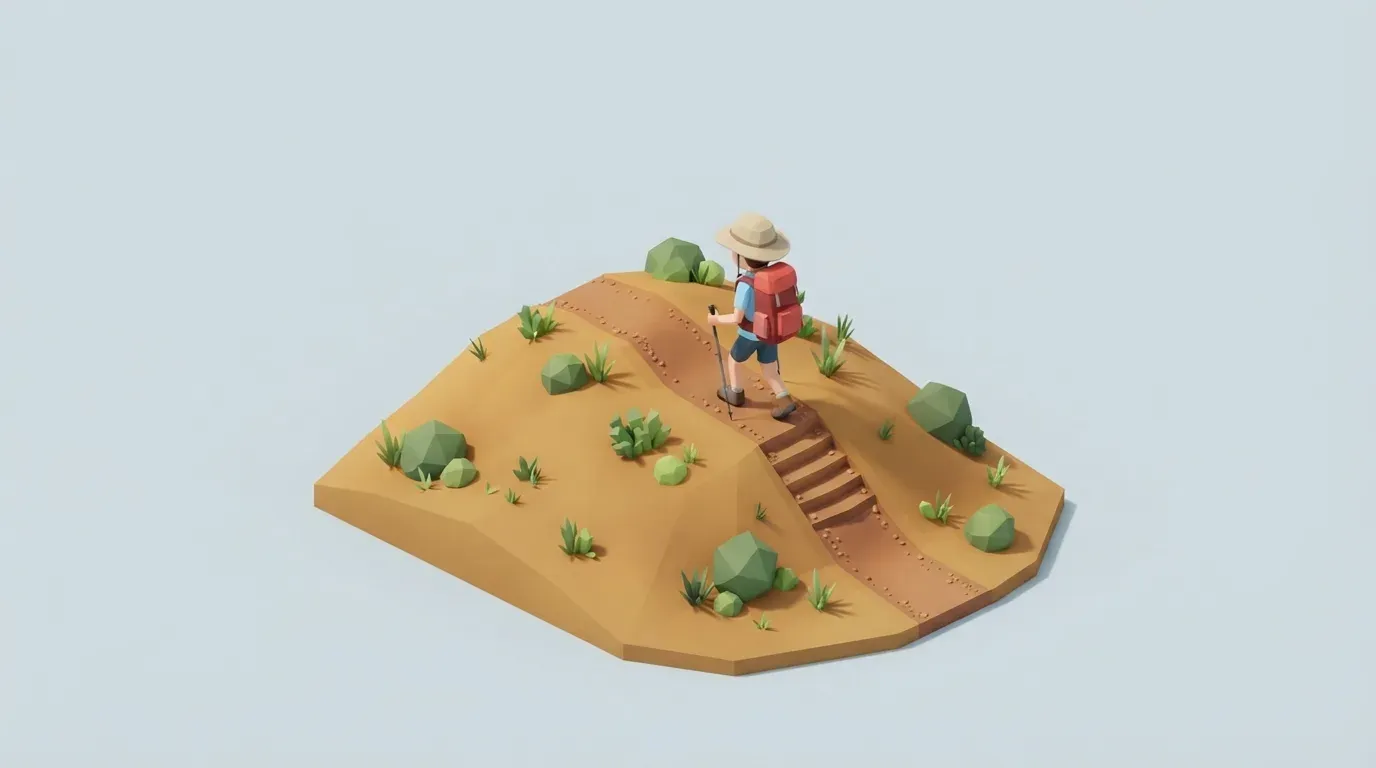
This B1 ESL lesson plan teaches the possessive 's, s' and of, from Colorado's peaks to the top of the mountain, with fourteener trail crews.
- Grammar
- 's for people, animals, places, groups and time (a day's hike), s' for plurals in -s (the volunteers' tools), and of for parts of things and long phrases.
- Topic
- Colorado's fourteeners, the peaks over 14,000 feet, and the crews and volunteers who repair their trails, with words such as trailhead, treeline and tundra.
- Activities
- A feature to read, a day on a trail crew and a listener's first summit to hear, self-checking drills, a hike-planning chat and open boxes.
What's inside
Chapter 1Warm-up: lace up your boots!
Chapter 2Let's read: 58 peaks, or 53?
Chapter 3Let's listen: Riley joins the trail crew
Chapter 4Grammar: Colorado's peaks, the top of the mountain
- Study the scheme: 's, s' or ofGrammar schemeTry it
- Choose the correct optionChoose the optionUnlock
- Fill in the gaps: add 's or 'Fill in the gapsUnlock
- Fill in the table: one owner or more than one?Fill in the tableTry it
- Drag the words into the gaps: whose is it?Drag and dropUnlock
- Choose the correct answer: which sentence is correct?QuizUnlock
Chapter 5Let's talk: plan a fourteener hike
Chapter 6Homework
- Match the words and the meaningsMatchUnlock
- Unscramble the wordsAnagramUnlock
- Fill in the gaps with the lesson's wordsFill in the gapsUnlock
- Find the matching pairs: words and meaningsMemory gameUnlock
- Choose the correct option: new sentencesChoose the optionUnlock
- Fill in the gaps: add 's or 'Fill in the gapsUnlock
- Put the words in the correct orderUnjumbleUnlock
- Choose the correct answer: which sentence means the same?QuizUnlock
- Choose the correct option: the trail crew's postChoose the optionUnlock
- Drag the words into the gaps: Riley answers LorraineDrag and dropUnlock
Vocabulary
12 words and phrases from the lesson, each with a picture and audio in edio.
+9 more with pictures and audio in the lessonMore words
- exhausted
- ridge
- treeline
- tundra
- boulder
- trailhead
- power tool
- botanist
- altitude sickness
Grammar: possessive 's, s' or of
The possessive 's goes after an owner: Riley's backpack, Colorado's peaks, a day's hike. For parts of things and long phrases, English uses of instead: the top of the mountain. On a fourteener trail, students place the apostrophe for one owner or many, and keep it out of plain plurals and its.
Colorado's peaks, the top of the mountain
Use 's or s' when someone or something has something: people, animals, places, groups and time. Use of for parts of things and with long phrases.
's for people, animals, places, groups and time
Add 's to a person or a name, an animal, a place, a group or a time word: my dad's boots, Footnote's bed, Colorado's peaks, the crew's lunch, tomorrow's weather. Time words take 's too: Longs Peak is a long day's hike.
| Who or what | Form | Examples |
|---|---|---|
| a person or a name | + 's | Riley's backpack, Lorraine's first fourteener, my dad's boots |
| an animal | + 's | Footnote's bed, the dog's water bowl |
| a place | + 's | Colorado's peaks, Kansas City's bookstores |
| a group | + 's | the crew's lunch, CFI's count |
| time | + 's | a day's hike, today's job, tomorrow's weather |
One owner or more than one?
One owner takes 's: the volunteer's gloves. A plural ending in -s takes only the apostrophe: the volunteers' gloves, the hikers' boots, two weeks' work. A plural with no -s takes 's: the children's trail, people's bags, the women's crew.
| Owner | Form | Examples |
|---|---|---|
| one (singular) | + 's | the volunteer's gloves (one volunteer) |
| a plural with -s | add only ' after the s | the volunteers' gloves (ten volunteers), the hikers' boots, two weeks' work |
| a plural with no -s | + 's | the children's trail, people's bags, the women's crew |
's or of?
Of is for parts of things: the top of the mountain, the end of the trail. A long phrase takes of as well: the name of the trail they built, not the trail they built's name. Some mountain names have no apostrophe at all: Longs Peak, Grays Peak.
's or of?
's: people, animals, places, groups, time
- Riley's gloves
- the crew's truck
- a day's work
of: parts of things, long phrases
- the top of the mountain
- the end of the trail
- the name of the trail they built
Long phrases and mountain names
With a long phrase, use of: the name of the trail they built (not: the trail they built's name). And some mountain names have no apostrophe at all: Longs Peak, Grays Peak, Torreys Peak.
Plural, possessive or its?
A plain plural has no apostrophe: Two volunteers came late, not volunteer's. The apostrophe appears only when someone has something. Its, meaning of it, has no apostrophe: the trail and its steps; it's means it is.
Plural or possessive?
A plain plural has no apostrophe: Two volunteers came late (not: two volunteer's). Use an apostrophe only when someone has something: the volunteers' tools. And its (= of it) has no apostrophe: the trail and its steps. It's = it is.
On the mountain
- Colorado's fourteeners are all higher than 14,000 feet.
- The volunteers' tools are gloves, hard hats and rock bars.
- Longs Peak is a long day's hike.
- The tundra's plants grow very slowly.
- Riley didn't climb to the top of the mountain.
- Lorraine wore her dad's old boots.
Common mistakes
Two volunteer's came late.
Two volunteers came late.
a plain plural: no apostrophe
the childrens' trail
the children's trail
children has no -s: add 's
It's a days hike.
It's a day's hike.
time words take 's too
the trail they built's name
the name of the trail they built
a long phrase: use of
More lessons on this grammar: Possessive adjectives and pronouns lessons and exercises
Try the possessive 's exercises
Try them yourself: these are the same exercises your students do in edio.
What's in the lesson
- 18 auto-checked exercises
- 5 games
- 1 article
- 1 grammar scheme
- 1 set of word cards
- 2 audio clips
- 2 pictures
- 2 transcripts
The main objectives of this lesson are to:
- add 's to people, places, groups and time: Lorraine wore her dad's old boots. Colorado's highest peak is Mount Elbert. It's a day's hike.
- put the apostrophe after a plural -s, and use 's after children and people: the volunteers' tools, two weeks' work, the children's trail
- use of for parts of things and long phrases: the top of the mountain, the name of the trail they built
- plan a hike with possessives and safety tips: We can take my brother's car. Then we turn around, even near the top of the mountain.
Lesson 29 opens Adventure and challenge, unit 8 of English B1.2 · Changemakers. It builds on A1.1 lesson 6, where the possessive 's first appeared with pets, and on A1.2 lesson 28's Whose…? with mine and yours. Lesson 30 turns to must and can't for deductions. A mountain full of owners, from Colorado's peaks to the volunteers' tools and a day's hike, calls for every kind of possessive.
Students spin a wheel of questions about hiking, heights and challenges, then learn twelve words, from haul and replant to altitude sickness, with pictures and audio. They read Riley's feature on Colorado's fourteeners and the people who repair their trails, then hear her spend a day with Ferris on a volunteer trail crew and a message from Lorraine about her first summit, both AI-voiced. The grammar chapter has the scheme and five self-checking drills, among them a table that turns one owner into many. In the speaking chapter, students plan a fourteener hike in Eunice's chat, then open boxes about challenges and views.
All ten homework tasks check themselves: a word match, an anagram, a word gap-fill and a memory game, then a choice of forms in new sentences, gaps for 's or ', word order, a same-meaning quiz, the trail crew's post and Riley's reply to Lorraine with words to drag.
- Grammar:
- possessive 's · plural possessive s' · 's or of · a day's hike
- Topic:
- Colorado · fourteeners · hiking · trail crews · volunteering · the Colorado Fourteeners Initiative · mountain safety · Stories That Travel
Teaching tips
- Start with things on the desks: hold up a pen and ask Whose is it? Students answer with a classmate's name, It's Sam's pen, then try things with two owners: the twins' bags.
- Before the feature, ask how many fourteeners Colorado has. Students guess, then read to find that it depends on the list: CFI counts 58, and other lists count 53 or 54.
- Play Riley's day on the trail twice: first for the crew's work, then for every possessive. Students write each one under 's, s' or of: today's job, the volunteers' tools, the top of the mountain.
- Turn the packing box into a pair task: students name five things for a day's hike and whose they are, my mom's hat or my friends' tent, and the partner says whether there is one owner or more.
Liked it?
Teach the whole lesson in edio
32 exercises in 6 chapters, ready to teach. edio is an online platform for language schools and teachers: ready-made interactive lessons, live classes, homework and student progress in one place.
Start a free trial
7 days, no credit card.
Open the lesson
Find it in the library of 621 ready lessons. Teach it as it is, or copy any chapter into your own lessons.
Teach it live or as homework
Students work in their own accounts, in sync with you during the lesson, and the practice exercises check themselves.
The whole course: English B1.2 · Changemakers
32 lessons for adults at B1 in American English, about people and ideas that changed things: start-ups, future cities, food, memory, customs, art, volunteers and adventure. The podcast team of English B1.1 is back for a season called Changemakers. Learners use the second conditional, the passive, reported speech, the past perfect, relative clauses and verb patterns, and the practice exercises check themselves.See the course
Unit 1 Start-up stories
the second conditional, If I were you, the first vs the second conditional, also, too, as well and besides
 Lesson 1The garage where Silicon Valley beganThe second conditional for imagined situations
 Lesson 2Would you sell lemonade to save bees?Second conditional questions and If I were you
 Lesson 3Pitch it to the Sharks!First vs second conditional: a real plan or a dream?
 Lesson 4A bakery that hires anyone?Adding ideas: also, too, as well, either and besides
Unit 2 Cities of tomorrow
the passive in the present simple and the past simple, with modals, and in the present perfect and present continuous
Unit 3 Food for the future
comparative and superlative adverbs, the future passive, verbs with prepositions, phrasal verbs with up, away and out
 Lesson 9Why did Carver tell farmers to plant peanuts?Comparative and superlative adverbs
 Lesson 10Lettuce from space?The future passive with will be
 Lesson 11Why do corn, beans and squash grow together?Verbs with dependent prepositions
 Lesson 12What happens to dining-hall leftovers?Phrasal verbs with up, away and out
Unit 4 Memory and learning
reported statements with say and tell, tense changes, time and place words, reported questions, requests and commands
Unit 5 Customs and manners
degree adverbs such as quite and pretty, the past perfect, the past perfect vs the past simple, make vs do
Unit 6 Art and design
relative clauses with whose, non-defining relative clauses, relative clauses without a pronoun, when and why
Unit 7 Volunteers and changemakers
verb + -ing or to, -ing as a subject and after prepositions, stop, remember, try and forget, prefer and would rather
 Lesson 25A day on, not a day off?Verb + -ing or verb + to
 Lesson 26The house that welcomed a neighborhoodGerunds as subjects and after prepositions
 Lesson 27A walk that lasted 24 hoursStop, remember, forget and try + to or -ing
 Lesson 28Head, heart, hands and healthPrefer, would rather and would prefer
Unit 8 Adventure and challenge
possessive 's vs of, must and can't for deduction, might, may and could for possibility, the meanings of get
 Lesson 29 · you're hereCould you climb a fourteener?Possessive 's, s' or of
 Lesson 30It must be here somewhere!Must and can't for deduction
 Lesson 31How did Houdini get out?Might, may and could for possibility
 Lesson 32A capital with no road inThe meanings of get