Possessive adjectives and pronouns: ESL lesson plans and exercises
Levels A1 to B1 6 lesson plans · 3 drill lessons Exercises that check themselves
Possessive adjectives and pronouns tell us who something belongs to: my mom, Emma's dog, It's mine. The edio.ai library has 6 ready-made lessons on them for A1 to B1 learners, all in American English, and this page brings them together. Try their exercises, see the rules from my to theirs in the lessons' own grammar schemes, and choose a lesson for your class from the list by level. Every lesson is interactive, and the drills, from his and her to whose, check themselves.
Possessive adjectives and pronouns lesson plans and drills
6 lesson plans and 3 drill lessons, A1 to B1. Lesson plans are whole lessons with reading, listening and speaking; drill lessons are 44 to 47 self-checking exercises with no new words.
 A1Lesson planEnglish A1.1
Why is Mother's Day in May?
 A1Lesson planEnglish A1.1
Best in show!
 A1Lesson planEnglish A1.1
National Best Friends Day
 A1Lesson planEnglish A1.1
Review: Bobbie the Wonder Dog
 A1Lesson planEnglish A1.2
Whose hat is this?
 A1DrillsGrammar Practice · A1
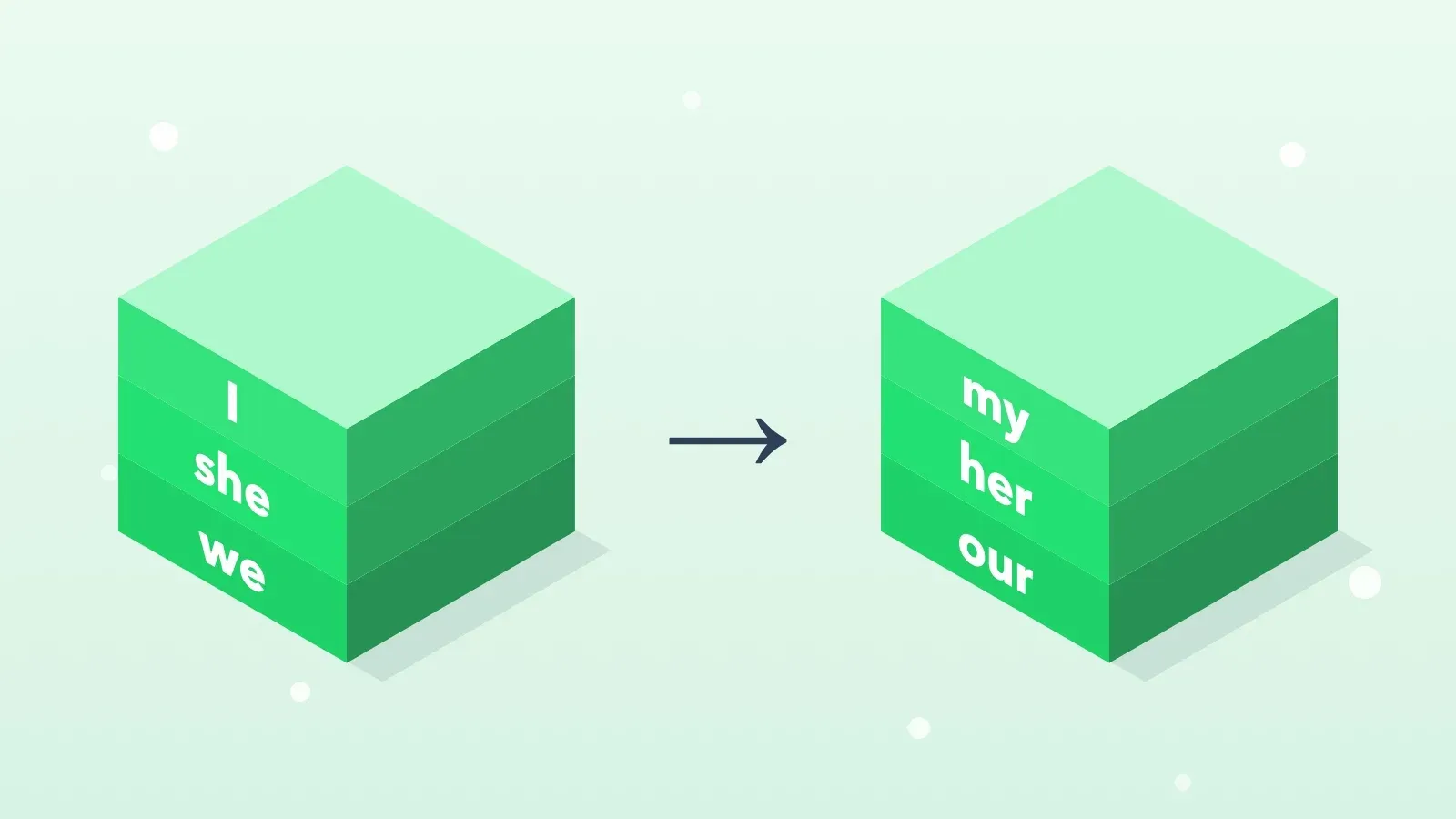
Subject pronouns and possessive adjectives: I, my, she, her
 A1DrillsGrammar Practice · A1
Possessive 's: whose bag is this?
 A2DrillsGrammar Practice · A2
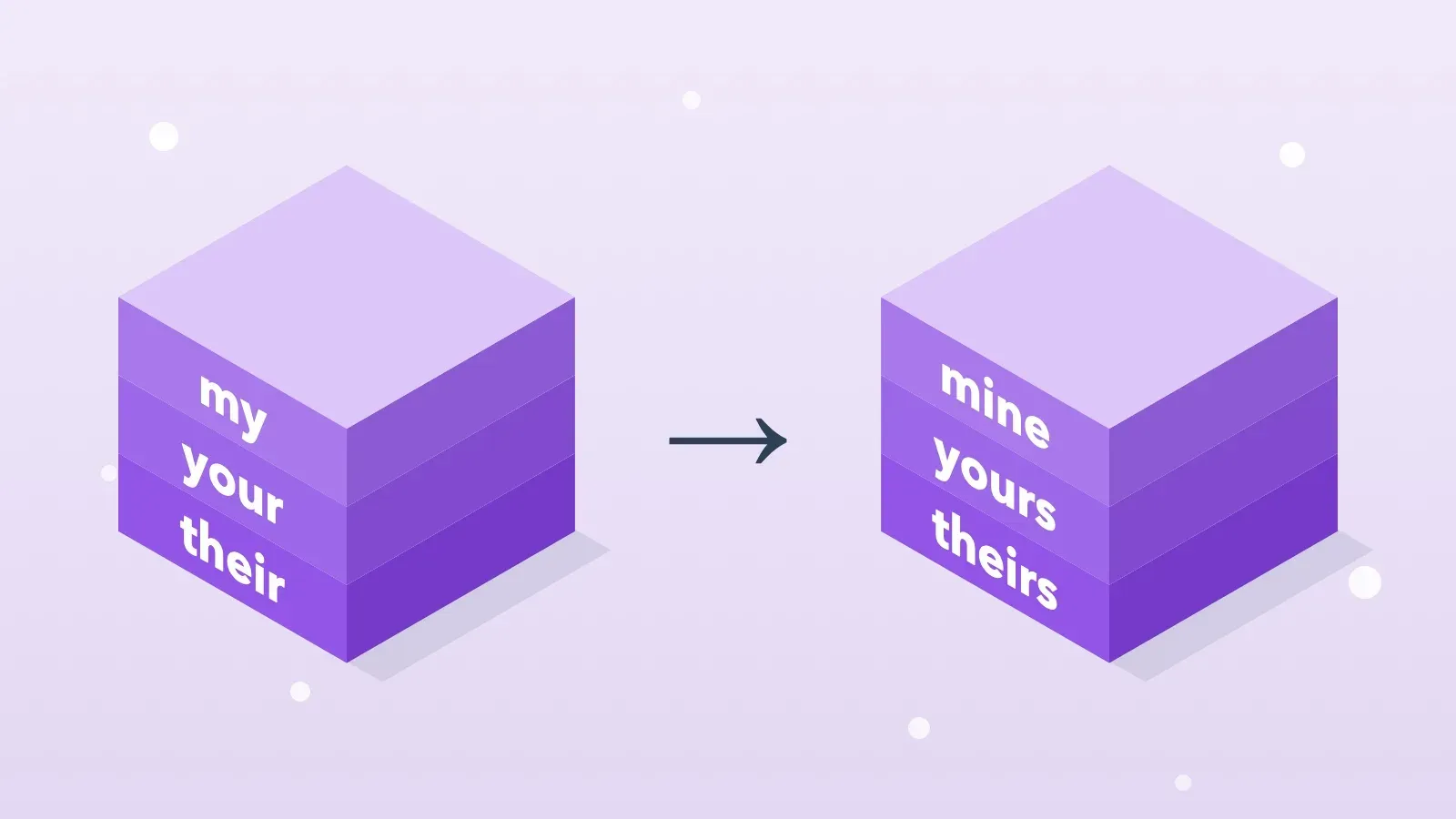
Possessive pronouns: whose is it?
 B1Lesson planEnglish B1.2
Could you climb a fourteener?
Try the possessive adjectives exercises
One exercise from each of 6 lessons. These are the same exercises your students do in edio.
Possessive adjectives and pronouns explained
Possessive adjectives (my, your, his, her, its, our, their) always come before a noun: our house. Possessive pronouns (mine, yours, his, hers, ours, theirs) stand alone, with no noun after them: It's mine. For a name, English adds 's: Ava's hat.
I → my, she → her: one for every person
Each subject pronoun has a possessive adjective of its own: I → my, we → our, they → their. An animal or a thing takes its: Its ears are brown. The table runs through every person, from My mom is in Detroit to Their mom is in Honolulu.
| I, you, he… | my, your, his… | Example |
|---|---|---|
| I | my | I'm Tunde. My mom is in Detroit. |
| you | your | You're Mia. Is your mom in Honolulu? |
| he | his | This is Liam. His mom is in Philadelphia. |
| she | her | This is Joy. Her son is Leo. |
| it | its | This is Pickle, a dog. Its ears are brown. |
| we | our | We're roommates. Our house is in Brooklyn. |
| they | their | Mia and Kai are from Hawaii. Their mom is in Honolulu. |
From the lesson Why is Mother's Day in May? (English A1.1)
His or her? Look at the owner
His and her follow the person who owns something, not the thing itself: Tunde and his mom, Mia and her brother. A common slip is Tunde and her mom, where her follows mom instead of Tunde.
his or her? Look at Tunde or Mia!
Tunde is a man: Tunde and his mom. Mia is a woman: Mia and her brother. Look at Tunde and Mia, not at mom or brother!
From the lesson Why is Mother's Day in May? (English A1.1)
Emma's dog: name + 's + thing
To say whose something is, add 's to the owner and put the thing after it: Emma's dog, the dog's name, not the dog of Emma. The same 's can also be short for is or has: Pickle's got brown ears.
Whose is it? Name + 's
name + 'sthing
Emma's dog
Max's owner
the dog's name
's: is, has or whose?
's = is
- Pickle's in the kitchen.
- Her name's Peaches.
's = has (with got)
- Pickle's got brown ears.
- She's got a blue collar.
's = whose
- Emma's dog is brown.
- Ruby's owner is Dana.
From the lesson Best in show! (English A1.1)
Its or it's, their or they're
Possessive adjectives never take an apostrophe. It's and they're are short for it is and they are, while its and their show the owner: Its name is Taco, Their photo is cute. There names a place: Danny is there.
it's or its?
it's = it is
- It's a small dog.
- It's very friendly.
its + name, ears…
- Its name is Taco.
- Its ears are really big.
they're, their or there?
they're = they are
- They're really funny.
their + person or thing
- Their photo is cute.
there = a place
- San Diego? Danny is there.
From the lesson National Best Friends Day (English A1.1)
My hat or mine? With a noun or alone
A possessive pronoun does the work of the adjective and the noun together: It's my hat becomes It's mine. Your, her, our and their add -s (yours, hers, ours, theirs), my turns into mine, and his stays his.
With a noun or alone?
+ noun: my, your, Ava's, our…
- It's my hat.
- It's Ava's hat.
- They're our badges.
no noun: mine, yours, hers, ours…
- It's mine.
- It's hers.
- They're ours.
my hat → mine: every person
| Who | + noun | no noun | Example |
|---|---|---|---|
| I | my hat | mine | Whose hat is this? – It's mine. |
| you | your hat | yours | Is this hat yours? |
| he | his hat | his | It's Noah's jacket. It's his. |
| she | her hat | hers | It's Ava's hat. It's hers. |
| it | its collar | – (not alone) | Pickle wears its blue collar. |
| we | our badges | ours | These badges are ours. |
| they | their booklets | theirs | Whose booklets are these? – They're theirs. |
From the lesson Whose hat is this? (English A1.2)
Whose hat is this?
Whose asks about the owner, and the noun comes right after it: Whose badges are these? The answer can use a name with 's or a possessive pronoun: It's Noah's. It's his.
Whosehat / badgesis this? / are these?
Whose hat is this? – It's mine.
Whose badges are these? – They're ours.
Whose jacket is that? – It's Noah's. It's his.
From the lesson Whose hat is this? (English A1.2)
Questions about possessive adjectives and pronouns
What are possessive adjectives?
Are there interactive exercises for possessive adjectives and pronouns?
What's the difference between possessive adjectives and possessive pronouns?
Is it his or her?
What's the difference between its and it's?
How do you use the possessive 's?
How do I teach possessive adjectives to beginners?
What are good possessive pronoun games?
Can students practice possessives at home?
More English grammar
Lessons for every grammar point, from the verb to be to reported speech. All grammar points