The robot car that crossed the desert: by vs until, within, throughout, in time vs on time
About this lesson
This B2 ESL lesson plan teaches by vs until, within and in time vs on time through the DARPA Grand Challenge, the desert race for cars with nobody at the wheel.
- Grammar
- By + a moment for a deadline, until for all the time up to it, within and throughout + a period, in time vs on time, and during vs for as a reminder.
- Topic
- DARPA's races of 2004 and 2005 and Stanford's robot car Stanley, with words such as sensor and obstacle.
- Activities
- A field story to read, a robot golf cart ride and a truck driver's voice memo to hear, self-checking drills, a test-drive chat and boxes to debate.
What's inside
Chapter 1Warm-up: who's driving?
Chapter 2Let's read: the race nobody finished
Chapter 3Let's listen: the cone that stopped a robot
Chapter 4Grammar: finish by nine, wait until it moves
- Study the scheme: by, until, within, throughoutGrammar schemeTry it
- Choose the correct option: by, until, within or throughoutChoose the optionUnlock
- Fill in the gaps: a deadline or all the time up to it?Fill in the gapsUnlock
- Choose the correct answer: which sentence is correct?QuizUnlock
- Fill in the table: the time word for each meaningFill in the tableTry it
- Drag the words into the gaps: Harper's travel planDrag and dropUnlock
Chapter 5Let's talk: robot cars, yes or not yet?
Chapter 6Homework
- Match the words and the meaningsMatchUnlock
- Unscramble the wordsAnagramUnlock
- Fill in the gaps with the lesson's wordsFill in the gapsUnlock
- Find the matching pairs: words and meaningsMemory gameUnlock
- Choose the correct option: new sentencesChoose the optionUnlock
- Fill in the gaps: use one of the words in bracketsFill in the gapsUnlock
- Put the words in the correct orderUnjumbleUnlock
- Choose the correct answer: what does it mean?QuizUnlock
- Choose the correct option: the race rulesChoose the optionUnlock
- Drag the words into the gaps: Harper answers RohanDrag and dropUnlock
Technology vocabulary
12 words and phrases from the lesson, each with a picture and audio in edio.
+9 more with pictures and audio in the lessonMore words
- sensor
- obstacle
- autonomous
- laser
- berm
- switchback
- time limit
- waypoint
- all-nighter
Grammar: time prepositions: by, until, within, throughout, in time and on time
Each of these time words answers its own question: what is the latest moment, how long does it go on, and were we early enough? DARPA's races had a time limit, a secret route and a winner named a day later, so learners match each time word to the question it answers.
Finish by nine, work until midnight
Time words that say when something must happen, how long it goes on and whether you're early enough.
By for a deadline, until for all the time up to it
By + a moment means at that moment or earlier: be back by 9:30. Until or till means all the time up to it: we worked until midnight. With a negative, until means “not before”: Stanley wasn't the winner until the next day.
By, until, within, throughout
| Time word | Meaning | Example |
|---|---|---|
| by + a moment | no later than: at that moment or earlier | The cart must be back by 9:30. |
| until (or till) + a moment | all the time up to that moment, and then it stops | The class worked until midnight. |
| not … until + a moment | not before: it happens at that moment, not earlier | Stanley wasn't the official winner until the next day. |
| within + a period | inside that period, before it ends | Finish the course within ten minutes. |
| throughout + a period | all through it, from start to end | It was windy throughout the test. |
By or until? Ask one question
Does the action go on all the time up to that moment? Use until: wait until nine, work until midnight, stay until the end. Does it happen once, at that moment or earlier? Use by: finish by nine, be back by noon, send it by Friday. Not: I'll finish until Friday. Not: We worked by midnight.
Within and throughout + a period
Within + a length of time means inside it, before it ends: within ten minutes. Throughout means all through it: throughout the night. A day or a clock time takes by: answer by Monday, not within Monday.
Within + a period, by + a moment
within + how long: within ten minutes, within two days, within an hour. by + one moment: by Friday, by noon, by October 5. Not: finish it within Friday. Not: finish it by two days.
In time, on time, during and for
In time means early enough, often with to + a verb: in time to see the first run. On time means at the planned time: The test started on time. During takes a noun (during the run), for a length of time (for an hour).
In time, on time, during, for
| Time word | Meaning | Example |
|---|---|---|
| in time (+ to + verb) | early enough to do something | We got there in time to see the first run. |
| on time | at the planned time: not late | The test started on time, at nine. |
| during + a noun | while an event or a period is going on | A cone fell over during the run. |
| for + a length of time | how long something goes on | The cart sat still for an hour. |
In time or on time?
In time means early enough, so it often comes with to + a verb: in time to see the start, in time to win. On time means at the planned time, not late: The bus is never on time. Not: We got there on time to see the start.
Common mistakes
Most slips mix up a deadline and a stretch of time: I'll finish the code until Friday needs by, and We worked on the cart by midnight needs until. Early enough to see something is in time: not on time to see the start.
I'll finish the code until Friday.
I'll finish the code by Friday.
one action and a deadline: by
We worked on the cart by midnight.
We worked on the cart until midnight.
it went on up to midnight: until
Please answer within Monday.
Please answer by Monday.
Monday is a moment, not a period
We got there on time to see the start.
We got there in time to see the start.
early enough: in time
In the desert and in the parking lot
- Teams had to finish the 2005 course within ten hours.
- By noon, about half of the robots had dropped out.
- The route stayed secret until two hours before the start.
- Throughout the summer, the team tested Stanley on weekends.
- TerraMax didn't finish in time to win the prize.
- Come back by noon: the next team always starts on time.
More lessons on this grammar: Prepositions lessons and exercises
Try the prepositions of time exercises
Try them yourself: these are the same exercises your students do in edio.
What's in the lesson
- 19 auto-checked exercises
- 5 games
- 1 article
- 1 grammar scheme
- 1 set of word cards
- 2 audio clips
- 2 pictures
- 2 transcripts
The main objectives of this lesson are to:
- tell a deadline from an action that goes on: send it by Friday, but work until two in the morning
- use within and throughout with a period: Finish the course within ten minutes. It was windy throughout the test.
- choose in time or on time: We got there in time to see the first run. The judges always start on time.
- understand not … until: Stanley wasn't declared the winner until about 24 hours later.
- plan a test with time limits and deadlines: Let's keep testing until it gets dark.
Lesson 2 is the second lesson of AI and the future of work, unit 1 of English B2.1 · How the World Works. It goes beyond the for, during and while of B1.1 lesson 26 and the until of B1.1 lesson 11, and its texts keep lesson 1's narrative tenses. Lesson 3 turns to how likely the future is. A race with a ten-hour limit, a secret route and a winner named a day later gives every time word a real job.
Students spin a wheel of questions about robot drivers and being late, then learn twelve words, from sense and navigate to berm and all-nighter, with pictures and audio. They read Harper's field story for The Why Desk on the races of 2004 and 2005, then ride with her in a robot golf cart that Nils's students built and hear Rohan, a truck driver from Nevada, answer back; both are AI-voiced. The grammar chapter has the scheme and five self-checking drills, among them Harper's travel plan with time words to drag in. In the speaking chapter, students plan a test drive with Cal by chat and open boxes about robot cars.
All ten homework tasks check themselves: a word match, an anagram, gaps with the lesson's words and a memory game, then new sentences to complete, a choice between two time words, word order, a quiz on what each sentence means, the rules of a parking-lot robot race and Harper's answer to Rohan with words to drag in.
- Grammar:
- time prepositions · by vs until · within and throughout · in time vs on time · during vs for
- Topic:
- DARPA Grand Challenge · Stanley · robot cars · Nevada · Primm, Nevada · AI and the future of work · The Why Desk
Teaching tips
- Draw two marks on the board: a dot anywhere up to Friday for by Friday, and a long arrow that runs right up to Friday for until Friday. Students put each sentence from the reading under one of them.
- Ask who is usually early, on time or late before the scheme. Students then say what they always arrive in time for and what never starts on time where they live.
- Play the golf cart ride twice: first for what happened to the cart, then for every time word, from within ten minutes and throughout the night to until the wind blew the cone over.
- Use the class's own deadlines: homework due by Thursday, a library open until eight, a test within forty minutes. Students make one sentence of each kind about their own week.
Liked it?
Teach the whole lesson in edio
33 exercises in 6 chapters, ready to teach. edio is an online platform for language schools and teachers: ready-made interactive lessons, live classes, homework and student progress in one place.
Start a free trial
7 days, no credit card.
Open the lesson
Find it in the library of 621 ready lessons. Teach it as it is, or copy any chapter into your own lessons.
Teach it live or as homework
Students work in their own accounts, in sync with you during the lesson, and the practice exercises check themselves.
The whole course: English B2.1 · How the World Works
32 lessons for adults at B2 in American English, each answering one question about how the world works. The team of The Why Desk, a small online magazine in Pittsburgh, takes on one question a week, from the day a computer beat the world chess champion to eight people sealed inside Biosphere 2. Learners tell stories with narrative tenses, speculate about the past and the future, and report what experts claim. The practice exercises check themselves.See the course
Unit 1 AI and the future of work
narrative tenses, by and until, be bound to and be likely to, the future perfect
 Lesson 1Checkmate: the day a computer beat the championNarrative tenses: past simple, past continuous and past perfect
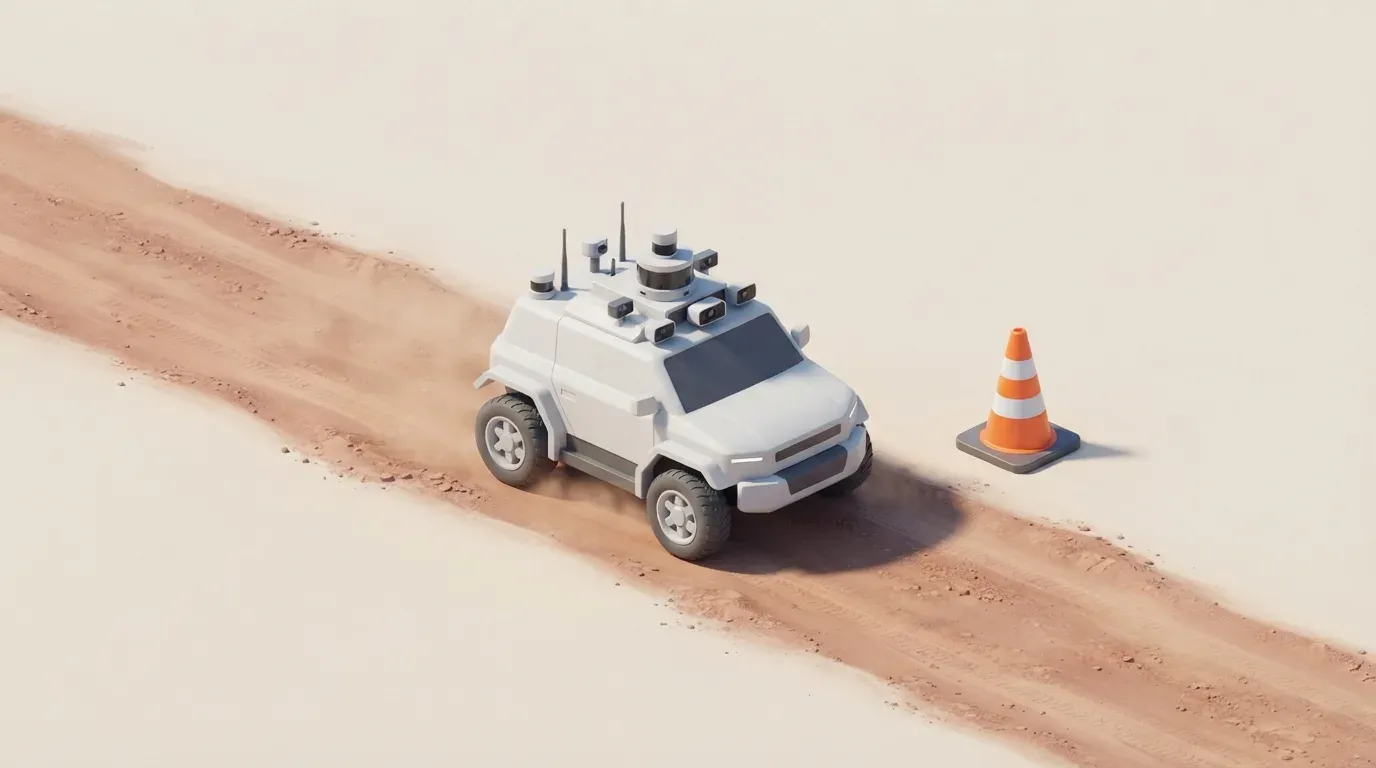 Lesson 2 · you're hereThe robot car that crossed the desertTime prepositions: by, until, within, throughout, in time and on time
 Lesson 3Can a chatbot fool you?Probability about the future: be bound to, be likely to, the chances are
 Lesson 4By 2035, what will AI have designed?The future perfect simple: will have + past participle
Unit 2 Health breakthroughs
the third conditional, the past perfect and past continuous passive, have something done, the passive with two objects
 Lesson 5The moldy melon that changed medicineThe third conditional: if + had done, would have done
 Lesson 61.8 million Polio PioneersThe past perfect passive and the past continuous passive
 Lesson 7One clinic, many doctorsHave / get something done
 Lesson 8A kidney from a twinThe passive with two objects
Unit 3 Moving people
the past perfect continuous, the passive infinitive and -ing form, it's worth and there's no point, the future in the past
 Lesson 9Six years to the golden spikeThe past perfect continuous vs the past perfect simple
 Lesson 10Riding a pod with no driverThe passive infinitive and the passive -ing form
 Lesson 11The town that painted bike lanes firstIt's worth, there's no point and it's no use + -ing
 Lesson 12The highways that were supposed to take 13 yearsThe future in the past
Unit 4 Wildlife comebacks
reporting verbs with a that clause, with an object and infinitive and with -ing, verbs of perception
 Lesson 13Did wolves really change Yellowstone's rivers?Reporting verbs + that clause
 Lesson 14Bringing a parrot back from the edgeReporting verbs + object + (not) to + base form
 Lesson 15The beavers that came by parachuteReporting verbs + -ing and verb + preposition + -ing
 Lesson 16Fifteen bison take the trainVerbs of perception + object + base form or -ing
Unit 5 Pop culture goes global
comment adverbs, wish and if only for the present and the past, have someone do and get someone to do
 Lesson 17The party that started hip hopComment adverbs: apparently, supposedly, undoubtedly
 Lesson 18Slide to the left!Wish and if only for wishes about now
 Lesson 19If only they'd kept SupermanWish and if only + past perfect for regrets
 Lesson 20The hit factory on West Grand BoulevardCausative have and get: have someone do, get someone to do
Unit 6 Money and smart choices
-ever words and no matter, should have and could have, prepositions for numbers and change, it's time and would rather
 Lesson 21The bank that never closed-ever words and no matter
 Lesson 22One marshmallow now or two later?Should have, shouldn't have and could have
 Lesson 23Benjamin Franklin's 200-year giftPrepositions for numbers and change
 Lesson 24Why buy a drill you'll use once?It's (high) time and would rather + past simple
Unit 7 Language and communication
must have, might have and can't have, verb prefixes and suffixes, past modals in continuous and passive forms, agreement with quantities
 Lesson 25How did one man write down a language?Past modals of deduction: must have, might have, can't have
 Lesson 26Why do Americans write “color”?Verb prefixes and suffixes: misspell, rewrite, simplify, shorten
 Lesson 27The joke that needed a smileyPast modals in continuous and passive forms
 Lesson 28Can preschoolers save a language?Subject-verb agreement with quantities and collective nouns
Unit 8 Exploring the extremes
dimension nouns, the future continuous and future perfect continuous, compound adjectives, only, even and just
 Lesson 29A walk on the ocean floorDimension nouns and phrases: depth, width, height
 Lesson 30Six months of night at the South PoleThe future continuous and the future perfect continuous
 Lesson 31Flying on pedal powerCompound adjectives with numbers and participles
 Lesson 32Two years under glassFocus adverbs: only, even, just and at all