Our Story: From Cart to Roastery – the present perfect and past simple for company history
About this lesson
This B2 Business English lesson plan teaches the present perfect for a company's story, with the past simple for its dates.
- Grammar
- The past simple for dated steps (We opened our first café in 2014.), the present perfect for results up to now (Our team has grown.), and since, for and yet.
- Topic
- A coffee company's history, from one cart to twelve cafés, on its website and on a new hire's roastery tour, with words like milestone and word of mouth.
- Activities
- An Our story page to read, a roastery tour to hear, self-checking drills, a LinkedIn chat and a story wheel, then an About us text and a recorded story.
What's inside
Chapter 1Warm-up: Where It All Began
Chapter 2Reading: The "Our Story" Page
Chapter 3Listening: The Grand Tour
Chapter 4Grammar: Back Then or Up to Now?
- Study the scheme: past simple or present perfect?Grammar schemeTry it
- Choose the correct tenseChoose the optionUnlock
- Fill in the gaps: a profile for the staff newsletterFill in the gapsUnlock
- Drag the time words into the gapsDrag and dropTry it
- Fill in the table: irregular verbs in company storiesFill in the tableUnlock
- Choose the correct sentenceQuizUnlock
Chapter 5Speaking: Your Story So Far
Chapter 6Homework: Tell Your Own Story
- Fill in the gaps: Claire's LinkedIn postFill in the gapsUnlock
- Find the matching pairs: phrases with the same meaningMemory gameUnlock
- Write an "About us" text or a LinkedIn "About" sectionWriting, checked by the teacherUnlock
- Record your story: your company or your careerSpeaking, checked by the teacherUnlock
Business growth vocabulary
10 words and phrases from the lesson, each with a picture and audio in edio.
+7 more with pictures and audio in the lessonMore words
- expand into a market
- take on staff
- a track record
- word of mouth
- break even
- a customer base
- go from strength to strength
Grammar: present perfect and past simple for company history
A company's story needs two tenses. The past simple tells what happened at a finished time, step by step: In 2014, we opened our first café. The present perfect gives results up to now and what hasn't happened yet: We've never had a café outside the US. Learners put each milestone on a timeline, choose since or for, place the time words and ask When…? or How long…?
Past simple or present perfect?
Finished time or up to now? How to tell a company's story and talk about your career.
A company's story on a timeline
Dated points take the past simple: 2012: Claire started with one cart. 2014: the first café opened. A span that runs up to now takes the present perfect, have or has + past participle: Since 2018, wholesale has grown. Watch the irregular participles: grown, built, chosen, won.
Wrenfield's story on a timeline
- 2012: Claire started with one cart
- 2014: the first café opened
- since 2018: wholesale has grown
- now: 12 cafés, about 180 people
The present perfect
have / has(just, already, ever, never)past participle
We have opened cafés in Salem and Seattle. Tom's just joined the team.
Negative and question: We haven't opened a café abroad yet. Have you met Ryan?
Irregular: grow → grown, begin → begun, build → built, choose → chosen, take → taken, win → won, sell → sold, buy → bought
Finished time or up to now?
A finished time takes the past simple: in 2012, last year, three weeks ago. The present perfect covers experience, a result now, or a period still going: Have you ever worked with hotels? The samples haven't arrived yet. We've had a partner in Hamburg since last year.
| Use | Time words | Example |
|---|---|---|
| Past simple: a finished time, said or clear | in 2012, last year, three weeks ago, when I was…, yesterday | Claire set up Wrenfield in 2012. |
| Past simple: a story, step by step | then, after that, soon, a year later | We moved into the warehouse and started roasting. |
| Present perfect: experience up to now, no time given | ever, never, before | Have you ever worked with hotels? |
| Present perfect: a past action with a result now | just, already, yet | The samples haven't arrived yet. |
| Present perfect: a period that is not over | since, for, so far, this week, How long…? | We've had a partner in Hamburg since last year. |
Since, for and the other time words
Since takes a point in time and for a length: We've had the roastery since 2017. Just, already, ever and never go between have and the participle, yet ends negatives and questions, and ago takes the past simple: She left three weeks ago.
since or for?
since + a point in time
- since 2018 · since last year · since March · since I joined
- We've had the roastery since 2017.
for + a length of time
- for a week · for six months · for years
- Tom has worked here for a week now.
- A finished period takes the past simple: I worked in a café for three years.
Where do the time words go?
- just, already, ever, never: between have/has and the participle: We've already met.
- yet: at the end of negatives and questions: Have you met Ryan yet?
- so far, since…, for…: at the start or at the end: So far, it's been a good year.
- ago: after the length of time, with the past simple: She left three weeks ago.
- American English: in conversation, the past simple is common with just, already, yet: I just got back. Did you meet Ryan yet? Practice the present perfect here.
When…? or How long…?
When…? asks for a finished time, so it takes the past simple: When did you join? How long…? takes the present perfect: How long have you worked here? This morning depends on the clock: I've had three calls at 10 a.m., I had three calls at 4 p.m.
Questions and stories
When…? takes the past simple: When did you join? How long…? takes the present perfect: How long have you worked here? For experience, ask Have you ever…?; Did you ever…? usually fits a finished period (In college, did you ever…?). At work, give the news in the present perfect, then the details in the past simple: I've worked with hotels before. I managed two in my last job.
this morning, this week, this year
Is the period still going on? Use the present perfect: It's 10 a.m. I've had three calls this morning. Is it over? Use the past simple: It's 4 p.m. I had three calls this morning.
Typical mistakes at work
We have opened our first café in 2014.
We opened our first café in 2014.
A finished time (in 2014) needs the past simple.
I work here since March.
I've worked here since March.
since + up to now needs the present perfect.
I've worked in sales since five years.
I've worked in sales for five years.
since + a point in time; for + a length of time.
When have you joined the company?
When did you join the company?
When…? asks about a finished time: past simple.
More lessons on this grammar: Present perfect lessons and exercises · Past simple lessons and exercises
Try the present perfect for milestones exercises
Try them yourself: these are the same exercises your students do in edio.
What's in the lesson
- 11 auto-checked exercises
- 3 games
- 2 teacher-checked tasks
- 1 article
- 1 grammar scheme
- 1 set of word cards
- 1 audio clip
- 1 picture
- 1 transcript
The main objectives of this lesson are to:
- tell a company's story in the past simple, with dates and steps: In 2017, we moved into a former warehouse and started roasting our own coffee.
- give results and news up to now in the present perfect: We've built a customer base of about 300 clients. We haven't opened a café abroad yet.
- choose since or for, and ask When did you join? or How long have you worked here?
- write an About us text or a LinkedIn About section with milestones, results so far and what's next
Lesson 2 of Business English B2 · A Year at Wrenfield continues the unit First contacts. It picks up where lesson 1's scheme stopped, at since and for, and brings the present perfect vs past simple, first contrasted in English A2.2, to work: company milestones, careers and When did you join? Lesson 3 then turns to question tags at a business lunch. A company's story is where the two tenses meet: the dates of its milestones, and what it has achieved since.
The warm-up starts with discussion boxes about company stories and careers, then ten word cards with pictures and audio, from set up a business to go from strength to strength, and a matching task. Students read the Our story page of Wrenfield, a fictional coffee roaster in Portland, Oregon, from one green cart in 2012 to twelve cafés, then hear its founder show a new account manager around the roastery in an AI-voiced dialogue with a quiz. After the scheme come five self-checking exercises, among them a table of irregular verbs in company stories. In the speaking chapter, students answer an office manager's LinkedIn messages as the new account manager, then spin a wheel to tell their own story.
Homework has two self-checking tasks, a gap-fill on the founder's LinkedIn post and a memory game of phrases with the same meaning. Students then write an About us text or a LinkedIn About section and record a two-minute story of their company or career; the teacher reviews both.
- Grammar:
- present perfect · past simple · present perfect vs past simple · since and for
- Topic:
- company history · company profile · career milestones
Teaching tips
- Put four years on the board before the reading: 2012, 2014, 2017 and 2018. Pairs guess what happened in each, then check against the Our story page and add a line for today.
- Pause the roastery tour after each question and have students predict the answer: a date and the past simple for When did you open the first café?, the present perfect for Is there anything that hasn't worked out yet?
- With an in-company group, build the employer's timeline together: dates and milestones in the past simple, then three present perfect sentences about what has changed since.
- For one-to-one professionals, rework their LinkedIn summary: which lines need a date and the past simple, and which need since or for? The homework's About section can then be the real thing.
Liked it?
Teach the whole lesson in edio
22 exercises in 6 chapters, ready to teach. edio is an online platform for language schools and teachers: ready-made interactive lessons, live classes, homework and student progress in one place.
Start a free trial
7 days, no credit card.
Open the lesson
Find it in the library of 621 ready lessons. Teach it as it is, or copy any chapter into your own lessons.
Teach it live or as homework
Students work in their own accounts, in sync with you during the lesson, and the practice exercises check themselves.
The whole course: Business English B2 · A Year at Wrenfield
20 lessons at B2 in American English that follow a year at Wrenfield Coffee Roasters in Portland, Oregon, as founder Claire Morgan and her team win a Dutch hotel contract. Learners network, write emails, run meetings, negotiate, handle complaints and present figures, with one grammar point per lesson.See the course
Unit 1 First contacts
networking, a company story, a business lunch and emails: present tenses, the present perfect, question tags, indirect questions
 Lesson 1Making ContactsPresent simple and present continuous at work
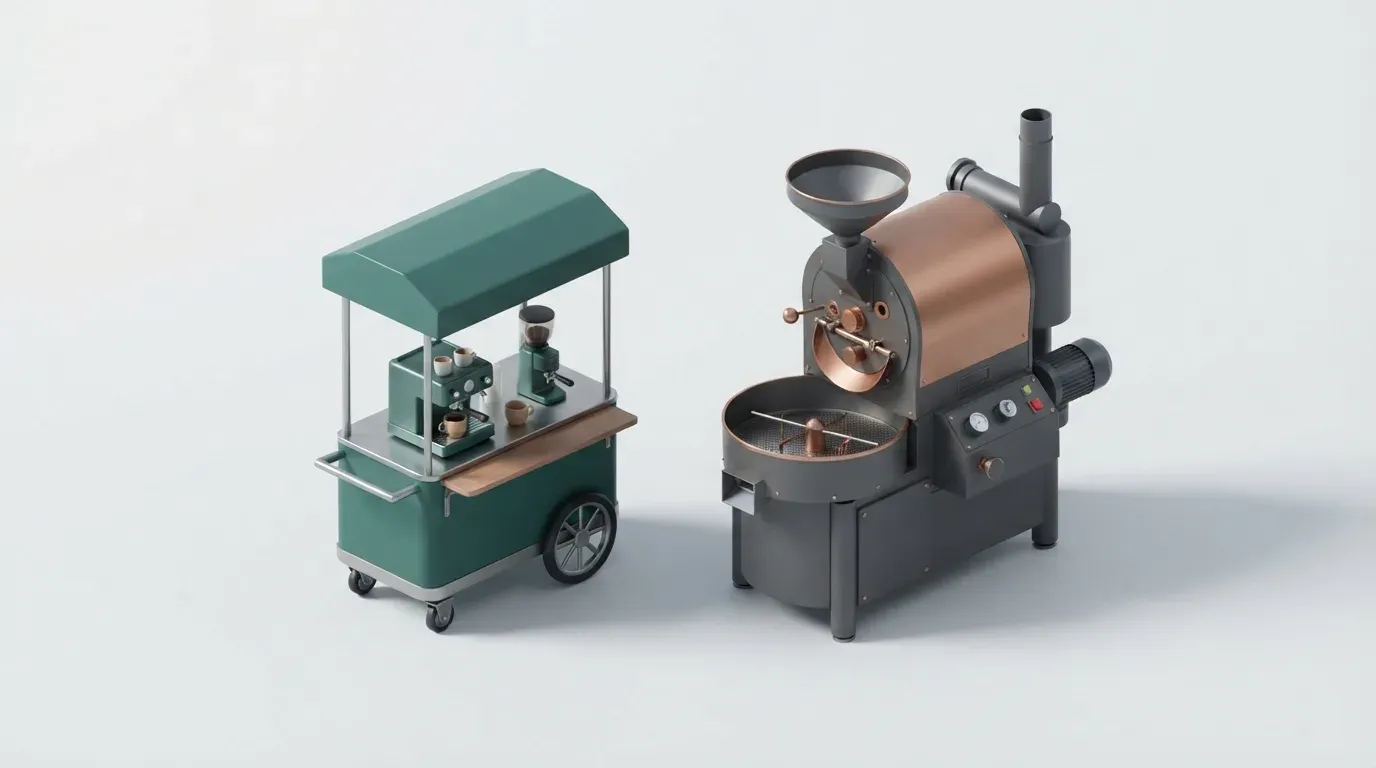 Lesson 2 · you're hereOur Story: From Cart to RoasteryPresent perfect and past simple for company history
 Lesson 3The Business LunchQuestion tags and short answers
 Lesson 4Emails That Get AnswersIndirect questions and polite requests
Unit 2 Meetings and figures
scheduling, sales figures, running a meeting and negotiating: future forms, trends, gerunds and infinitives, conditionals
Unit 3 Problems and growth
a complaint, a late shipment, a launch and hiring: the present perfect continuous, the passive, comparatives, relative clauses
Unit 4 Reports, prices and feedback
reporting back, explaining prices, expenses and feedback: reported speech, linking words, modals of obligation, past modals
Unit 5 Looking back and ahead
what went wrong, other cultures, an agency and next year: the third and mixed conditionals, past deduction, the causative, the future perfect